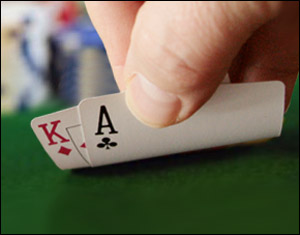
Gambling is a risk taking behavior where money or valuables are wagered and bets are placed on an outcome that is uncertain. Gambling urges are present despite harmful negative consequences (or a desire to stop). There are three elements to gambling: payoff; element of chance; a stake that is risked. Problem gambling is also characterized by difficulties in limiting money and/or time spent on gambling which leads to adverse consequences for the gambler.
Categories of gambling
- Gaming — playing for money in any game of chance, such as slot machines, roulette, bingo, pay-off pinball machines, punch boards, pyramid money games, poker, black-jack, etc.
- Betting — staking money on an event which the outcome is doubtful. Examples are, horse or dog racing, cock or dog fights, tennis, hockey, football, basketball, hockey, baseball, pool, etc.
- Lotteries – A lottery is the distribution of prizes by the drawing of lots. There is a variety of lotteries, including 6/49 and Super 7.
- Sweepstakes and Raffles – A raffel is a lottery where each participant is buying a chance to win. It includes buying a ticket or two for a good cause, with the purpose of it being a donation to a worthy organization.
- Pools – A combination of betting and lotteries. The most popular is the check pool at work, though there are football pools, etc.
Some common reasons people gamble are:
- To Win Money: There is an opportunity to come out “ahead of the game”. The dream of the “big win”. Financial difficulties can encourage people to gamble in the hope of winning money.
- For Recreation: The shared experience with other gamblers, the language specific to the game of choice, and the sense of belonging to a distinct group of individuals are all factors that contribute to the social aspect of gambling.
- To Support Charity: For some gamblers, the opportunity to be entertained while supporting a worthy cause is an incentive to participate.
- To Escape Problems: Gambling may be an escape from problems, depression, or negative feelings. Some people gamble out of boredom and loneliness.
- Mood Alteration: Gambling in its benign form provides stimulation and excitement. The action and excitement of gambling can be used as a form of escapism. Gamblers may experience a “high” while playing, similar to the high brought about by drugs or alcohol.
There are many risk factors for problem gambling. Risk factors are things that make a person more likely to develop gambling problems. A person is more at risk if they:
• had a “big win” early in his or her gambling history
• experience money problems
• experienced a recent loss or change (relationship problems, divorce, job loss, retirement or the death of a loved one)
• gamble to cope with a health concern and/or physical pain
• feel lonely, bored, anxious, and/or depressed a lot of the time
• have limited interests and hobbies, or feels his or her life lacks direction
• are risk-taker, or act without thinking
• uses gambling, or alcohol or other drugs, to cope with bad feelings, or events
• had been abused or traumatized
• have (or had) problems with alcohol or other drugs, gambling, or overspending
• are in a family where someone has had problems with alcohol, drugs, gambling or overspending
• think he or she has a system or a way of gambling that increases his or her odds of winning.
Signs of Problem Gambling
- Feelings of guilt about gambling
- Lying about or hiding evidence to cover-up gambling
- Gambling to escape personal problems
- Betting more than intended or can afford to lose
- Increasing gambling frequency and amount of time spent gambling
- Chasing gambling losses
- Borrowing money or selling items to get money to gamble
- People criticizing gambling behavior
- Personal or financial difficulties caused by gambling
- Relationships with family, friends and/or employer jeopardized because of gambling
- Feeling irritable or moody when not gambling
- Feeling stressed-out or unable to sleep because of gambling
- putting gambling before other important life events (family, social or business functions)
According to DSM-IV, Pathological gambling is now defined as a separate category, . In order to be diagnosed, an individual must have at least 5 of the following symptoms (and the gambling behavior is not better accounted for by a Manic Episode):
- Preoccupation. The subject has frequent thoughts about gambling experiences, whether past, future, or fantasy.
- Tolerance. As with drug tolerance, the subject requires larger or more frequent wagers to experience the same “rush”.
- Withdrawal. Restlessness or irritability associated with attempts to cease or reduce gambling.
- Escape. The subject gambles to improve mood or escape problems.
- Chasing. The subject tries to win back gambling losses with more gambling.
- Lying. The subject tries to hide the extent of his or her gambling by lying to family, friends, or therapists.
- Loss of control. The person has unsuccessfully attempted to reduce gambling.
- Illegal acts. The person has broken the law in order to obtain gambling money or recover gambling losses. This may include acts of theft, embezzlement, fraud, or forgery.
- Risked significant relationship. The person gambles despite risking or losing a relationship, job, or other significant opportunity.
- Bailout. The person turns to family, friends, or another third party for financial assistance as a result of gambling.
With the increase in legalized gambling there has also been an increase in the types of help for problem gamblers. Some of the avenues to address problem gambling are:
- Treatment Centers
- Outpatient Programs
- Individual Counseling
- Gamblers Anonymous
- Other Self-Help Groups
- Individual research/books/Internet
Would like to assess your gambling? Answer this online gambling questionnare